The Framework
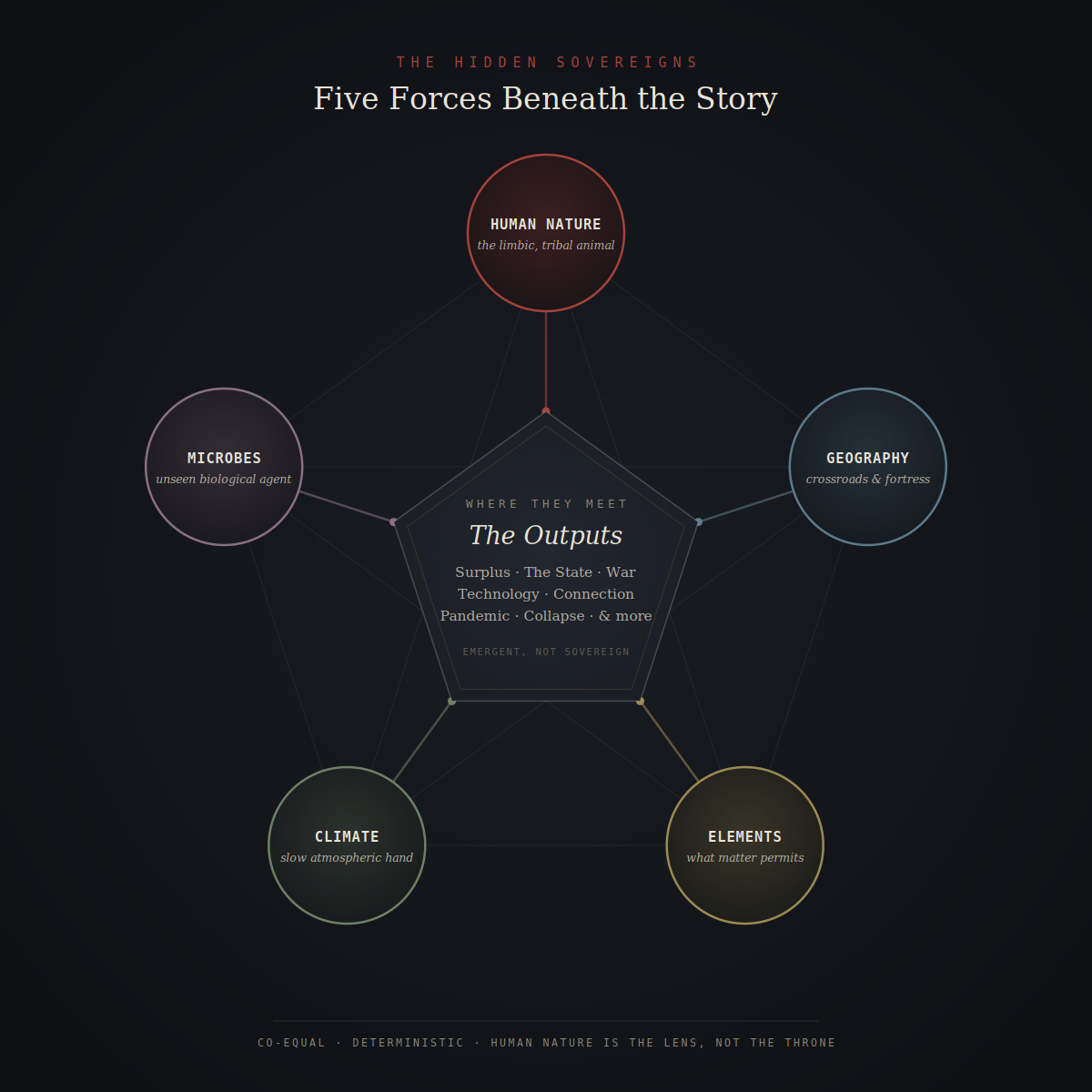
Beneath the surface of events, five forces do the real governing.
Human Nature, Geography, Elements, Climate, and Microbes — co-equal, deterministic, and mostly invisible. They are sovereign because they set the terms within which all human action plays out; hidden because we record the kings and battles while the forces beneath them go unreported.
Where they meet, they produce the recurring engines of the human story — surplus, the state, war, connection, pandemic, collapse. Human nature is the lens through which the other four express themselves: the one constant beneath the changing costumes.
Writing
Interactive Consoles
The Anatomy of State Violence
A comparative console of state violence across two eras — scored along seven dimensions of ideology, power, and scale.
The Signal Reader
A diagnostic that interrogates any historical episode against the five structural forces, surfacing which sovereign was truly at work.
The Causal Chain Explorer
Traces the long ladders of cause and consequence — surplus to hierarchy to state to collapse — forward or back through time.
The Disease & Connection Map
Maps the compounding logic of contact: how the same routes that carried trade and ideas also carried plague, rewriting the map again and again.
About
"History rhymes because human nature is constant even as its instruments change. The costumes differ across the centuries. The drama underneath is recognizable."
There is a particular kind of anxiety that comes from watching the present unfold and feeling, for the first time, that history offers no map for where we are. That the world has become something genuinely new. This project began as an argument against that feeling.
The thesis is simple, and it is offered not as comfort but as orientation: none of this is unprecedented. The fractures between elites and populations, the disruptions of transformative technology, the violence of states under pressure, the social fragmentation that follows rapid change — these are the recurring patterns of the human story, not its exceptions. They moved beneath Rome as the Republic collapsed. They moved beneath the Black Death and the Columbian Exchange. They have moved beneath every era that felt to those living through it like the end of something stable.
Hidden Sovereigns collects interactive tools, synthesis documents, and a single organising framework: that beneath the surface of events, a small set of structural forces — Human Nature, Geography, Elements, Climate, and Microbes — operate as the true governors of human societies across time and civilisation. They are co-equal, and mostly invisible. Where they combine, they produce the recurring engines of history — surplus and hierarchy, the state, war, connection, pandemic, collapse. Human nature is the lens through which the other four express themselves: the one constant beneath the changing instruments.
The framework is frankly deterministic, and offers that determinism not as despair but as a kind of peace: we are players upon a stage we did not build, and that is a more manageable thing to be than its author. It is also, emphatically, not a claim to originality. It is a personal synthesis of a distinguished body of work — Diamond on geography and germs, Morris on the material forces of history, Smil on energy and matter, Turchin on historical dynamics, Sapolsky on the biology of behaviour, and the deeper lineage of Braudel, Marx, and Montesquieu. The goal is to make that literature navigable and personal, and to hold the full sweep of it in one place as a lens on the present.
We are, at bottom, the unfinished animal. The same creature who built the first cities and burned them down. Understanding that is not resignation. It is the beginning of orientation.
Sources & Inspiration
A personal exploration, not original scholarship. The framework gathered here is a synthesis of a distinguished body of work — it distils and organises these thinkers’ research, and adds nothing to it. The fuller reckoning with where this project stands among them is laid out in Sources & Kindred Minds.
Disclaimer: The framework and syntheses gathered here are not original research or scholarship, and make no claim to see what these thinkers have missed. They are a personal exercise in reading, organising, and applying an existing body of work to make sense of the present — undertaken with the conviction that the established scholars know this ground far better than I do. The intellectual debt to the thinkers above — and to the broader fields of big history, cliodynamics, and historical sociology — is total. Where the framework feels cleaner or more total than theirs, the likeliest explanation is that I have read less, not seen further.